Wednesday, May 8, 2019

193. Pitch & } needle.


June 30, 2017, 8:48am, I sent the following pitch to M. at The Smart Set:

“Dear M., …I'm delighted and curious about the phenomenon of posting YouTube videos of an LP played on a record player…. I'd like to write a short essay about how weird it is—the way it blends hi-fi and lo-fi, analog and digital, while also creating a pleasing visual.”

M. liked the idea. She wrote, “At one point, I could only find Elton John’s Sick City in that YouTube format… it’s definitely a weird phenomenon….”

I began to look into that “weird phenomenon,” i.e., the “full vinyl rip” of, specifically, horror movie soundtracks. Consider Alan Miller’s typical (of the genre) post of Waxwork’s Creepshow soundtrack (by composer John Harrison): A shot of a Technics SL-D1 turntable, the Creepshow LP on the turntable, a corner of the LP sleeve visible to the left, and a little of (presumably) Miller’s apartment in the background; the record begins to spin and a hand (presumably Miller’s) moves the tone arm and lowers the needle—we’re about 20 seconds into the video when the music begins. Presentation varies a little. The record, shot from above, fills the frame. Decorations are assembled around the turntable. The LP is removed from its sleeve (often to show off clever packaging) and placed on the turntable. We see the LP as it’s flipped from side-a to side-b. Etcetera.

Generally, the people who publish these videos keep themselves anonymous, but the aforementioned Alan Miller included in his “about” page the name of the record store where he worked (this information has since been removed)—I wrote to his employer and shortly thereafter Miller replied.

I told Miller about the article-to-be-written and added, “There's something peculiar about these videos—watching someone's record on the turntable, watching the record run out and get turned over—It's wonderful.” And I asked a few questions. Eagerly, he answered.

He posts his videos because he “got tired of listening to 128k or less audio streams of some of my favorite [movie] scores” but finds “pointless” the debates from “the old audiophile gatekeepers” about “vinyl vs. CD vs. SACD vs insert format.” He simply wants “everyone to be able to hear how awesome these scores and soundtracks are!” I asked how he chooses what albums to post:

I try to pick albums that are rarer than others. If something has already been posted to YT [You Tube] in high quality audio, it seems a bit redundant for me to do the same. Copyright is a huge factor as well, with some rights holders being more aggressive than others. One of my more popular videos a few years back was the Mondo release of John Carpenter's Halloween on orange vinyl, a beautiful record but ultimately pulled (and a copyright strike taken against me) for using the audio.

A copyright strike, he explains, “are the bane of YT.” He says, “Google has software to monitor the audio/video content of everything posted to YT, so if it detects a pattern that is known to be copyright [sic] they will send you a notification….” According to Miller, a first strike prevents the uploading of videos longer than ten minutes for six months; the second takes away uploading abilities for ninety days; the third terminates the account. Google support states that the first two warnings “may affect your ability to monetize”—Miller made it clear that “there’s no monetary incentive here. I can’t make money off of copyrighted material (nor would I want to)….”

Aside from the pleasure of sharing music, Miller agrees that “we all like showing off our turntables, yes.” Because he worked at a record store, he was able to “trade often”—and thus show off a wide variety of equipment. (A favorite of mine is the Mitsubishi X-10—its turntable is vertical.)

I wrote to music critic Anthony Fantano for a little outside perspective—I saw a kinship between the album reviews he posts on You Tube and the enthusiasm for LPs Miller, et al, exhibit. Maybe my questions were lame—Fantano's answers certainly were. I asked, “In the face of a possible DMCA (Digital Millennium Copyright Act) takedown, why do you think people [post full vinyl rips]? He replied, “cuz they want to and don’t care cuz they’re not trying to do YT professionally.” As Fantano once tweeted, “well, yeah, but i’m a youtuber, so i’m going to respond to it in a video.” The written word is not his bailiwick.

I don’t know if these rips are good for the companies that specialize in collectible vinyl soundtracks. I don’t own any records from Mondo or Waxwork—I can’t afford them. Or, rather, I can’t justify paying $28 for Re-Animator, or $36 for Friday the 13th The Final Chapter, or $250 for the Nightmare on Elm Street 8LP box set—much though I wish I could. But I imagine that those who can do, because these records are not just about listening.

Watching an LP revolve on a turntable is a significant part of the pleasure of vinyl. Forget the arguments about audio fidelity. Vinyl is tactile first, audible second. The equipment required to listen to it, cheap or high-end, is simple. Ideally, you’re in the room with it, but the video posts please.

I never wrote the essay for The Smart Set.


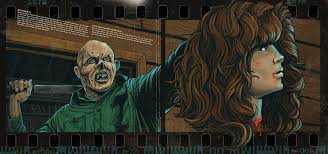
[ Photo: the inner sleeve art for Waxwork Records' Friday the Thirteenth pt. 3. ]

Friday, May 3, 2019

192. Clive Barker's babe } & Clive Barker's chair.


Re-watched Clive Barker’s Nightbreed (director’s cut, still a disappointment) and noticed in protagonist Boone’s apartment Peter Blake’s “Babe Rainbow.”

Not “noticed”—Barker cuts from a bottle of spilled pills to a hand-held shot of “Babe Rainbow” on a free-standing, wood paneled wall, surrounded by hubcaps. Cuts to another hand-held shot, this from behind Boone as he takes off his t-shirt and steps forward—toward “Babe Rainbow.”

Search Nightbreed + Clive Barker + Babe Rainbow and find “Now watching Nightbreed with my babe” and this quote from the film: “It’s all true. God’s an astronaut. Oz is over the rainbow, and Midian is where monsters live.”

“Babe Rainbow” is a screen print on tin; according to the University of Warwick Art Collection website, the central image, a woman dressed in a white bathing suit, is “based on a 1967 cover of the French magazine Marie Claire”—a cover image easy to track down (Joanna Shimkus is the model). The woman in the print takes a step forward, from a dark background, beneath an arch. Framing that arch is the rainbow. Beneath the woman are the words “Babe Rainbow.” 10,000 “genuine multiples” of the print were made.

Which means lots of people have an original copy of “Babe Rainbow”—there’s a copy down the hill from me at the RISD Museum. Apparently, Clive Barker has a copy too. And fictional character Boone, too. Why is “Babe Rainbow” so prominently featured in Nightbreed?

There’s lots written about how queer Nightbreed is. Yeahits coding is ABC. That quote about Oz, for one. Then there’s this exchange between two of the Nightbreed, Narcisse and Ohnaka: “Hey. Love those tattoos” [Ohnaka glances at the tattoos that circle his nipples, runs away; Narcisse, to himself, says] “Sailors.” There’s a priest who tries to stop the massacre of the Nightbreed by a mob of police—the sheriff calls him “faggot”; the sheriff is promptly killed by Boone, who warns the priest away, but the priest pulls off his collar and declares, “No. I have to see. Take me with you.” Once he does, he becomes Nightbreed and destroys the sheriffwho so obviously represents unthinking, violent, and frightened adherence to conformity. Read Trace Thurman’s “The Inherent Queerness of Clive Barker’s ‘Nightbreed’” for a light-hearted examination of other queer tropes in the film.

So, I wondered—is “Babe Rainbow” simply another signifier? Maybe. But why that rainbow?

Another possibility occurs to me. There’s Clive Barker the English horror author and film director and there’s Clive Barker the English pop artist. Clive Barker the pop artist made a collage portrait of Peter Blake; Blake and Barker have shown work together. Maybe director Barker was making an oblique shout-out to pop artist Barker?

(I first learned of Clive Barker the pop artist when I saw his “Van Gogh’s Chair” [1966] featured on the cover of Paul McCartney’s 1983 album Pipes of Peace. As you all know, Peter Blake and Jann Haworth executed Paul McCartney’s rough idea for the Sgt. Pepper’s Lonely Hearts Club Band album cover.)

Monday, April 22, 2019

191. Fragments } lost & found.


After “Cry Baby Cry,” Paul McCartney sings a little fragment: “Can you take me back where I came from / Can you take me back / Can you take me back where I came from / Brother can you take me back…”—an eerie excerpt from an unfinished cut, McCartney’s plaintive wish not to be lost anymore. To go home. Another fragment, “Golden Slumbers,” McCartney sings, “Once there was a way / to get back home.” From the same period, “Get Back” (“to where you once belonged”) and “Two of Us” (“…you and me Sunday driving / not arriving/ on our way back home / we’re on our way home…”). Is going back home simply a poignant idea that appealed to McCartney aesthetically, or something to do with personal crisis?

The flip-side of his anxious longing for home appears in the fragments of this era too. From the (rather complete) fragment “You Never Give Me Your Money” that begins the Abbey Road b-side suite: “But oh that magic feeling / Nowhere to go.” And another fragment, “The Lovely Linda,” that begins McCartney’s solo break.

Thursday, March 28, 2019

190. Napkins at } A Velvet Giant.


What do you do with this: “So excited and honored to have three poems alongside such incredible company in the latest issue of @avelvetgiant!❤️❤️❤️” [Spencer Williams]. It must make sense to somebody. I like Spencer Williams' poem “Masturbation”—in it, the narrator asks Adam to see if the dove that smacked into “the window” died. It did. In death it wears a crown of ants. The best poems in A Velvet Giant no. 3 are Karolina Zapal’s. But let’s be transparent: my name is Adam and my last name is Polish so naturally I’m biased. Kevin Latimer’s author’s photo deserves careful consideration. His poem “Back In the Backyard Again” led me to think about Stephon Clark, murdered in his grandmother’s backyard by the police: “black boy prepared for war / all his life.”

My contribution to A Velvet Giant no. 3 is four Napkin Poems. When I look at the issue on my laptop, I can’t view whole napkins—I wonder if on a desktop the experience is better? I do, however, like the close-up presentation, because the Napkin Poems are very much about texture. The actual napkins (as opposed to the scans) are now radically curled.