Monday, November 5, 2012

73. Her heart turned ruby } a reading.


[ X ], a former student of mine, was supposedly killed in a motorcycle accident. As always happens when an unremarkable young person dies, the lost potential of her life was lamented. “[ X ] had such a bright future ahead of her.” Who knows? I recall the last time I saw her. She came to my office, ostensibly to discuss an upcoming exam. She didn’t seem to care about the exam. Something else worried her—so she said. What, I don’t know. She sat in my office and stared into space. Even when she spoke, she stared. Finally, she said, “Something’s coagulating.” I said, “Do you mean, ‘coming together’?” She said, “Thanks professor,” and left. She was absent the next class and all the following week. The registrar informed me she was dead the week after finals, but everyone knew by then about the accident.

At the beginning of the next semester, I overheard two students at the college bookstore talking about [ X ]. One said, “…what was weird was some of her organs were found partially crystallized.”

How can that be true? It can’t be true. Nonetheless, I find the image of an organ from her body, her heart, say—turned crystal and lit from inside—often recurs.

A current student invited me to read with her creative writing class. She said she thought I was a poet because of the way I talk about poetry and lo, I am. Wednesday night I’ll read poems from The Rescue in the Central Connecticut State University Student Center. The reading begins at 7:30pm and will be over before you know it.

Friday, November 2, 2012

72. Specifically } the dance Nina makes.


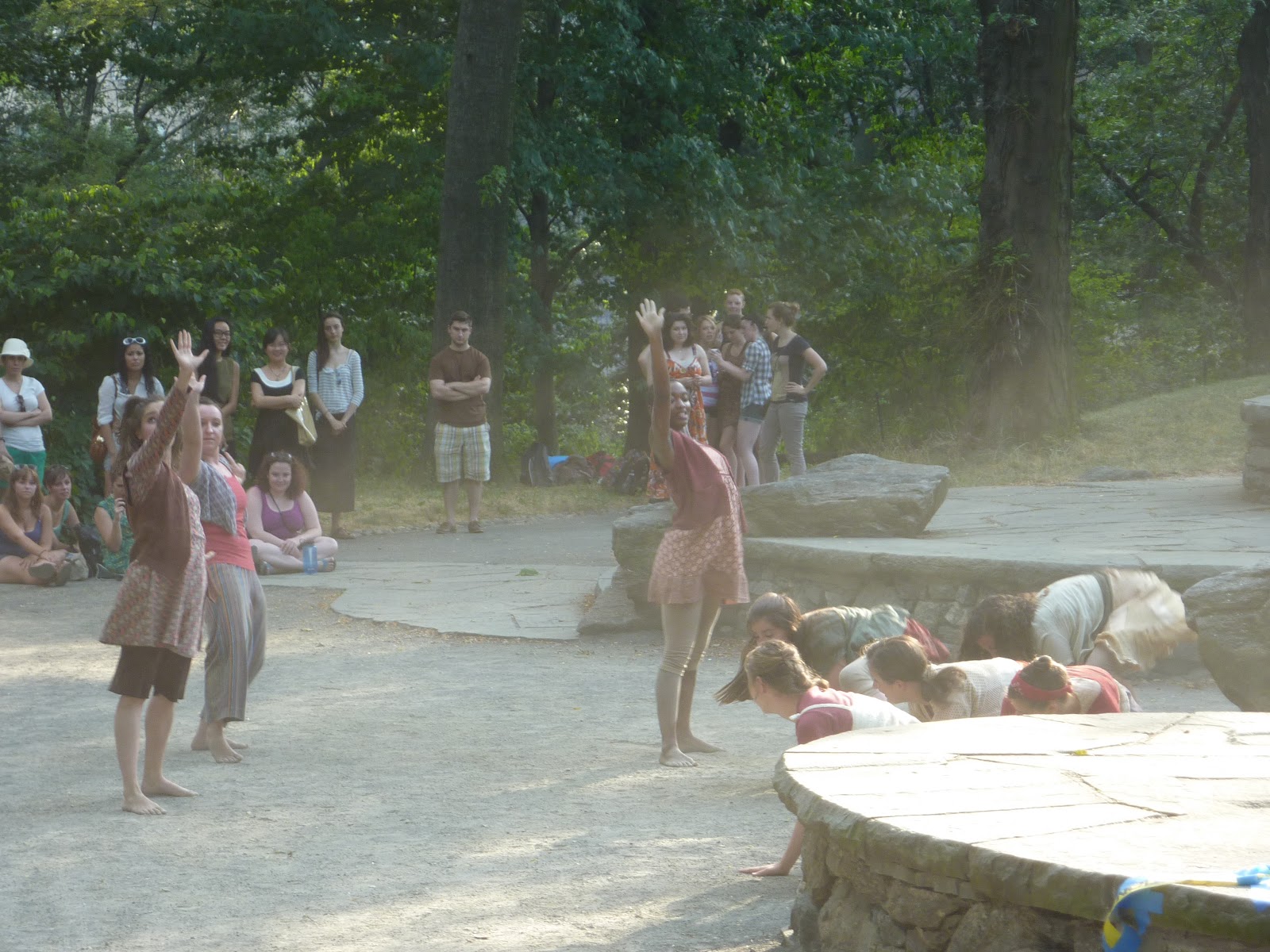
Nina Joly’s dance “Gobbledigook” was one of nine dances selected for inclusion in the Check Us Out Dance Festival. The festival was “a celebration of female choreographers” and was staged on Summit Rock in Central Park this past July. For Nina, the invitation meant reuniting (most of) the group who debuted “Gobbledigook” at Mt. Holyoke College, making adjustments to the choreography to suit the park space, and arranging rehearsals, first at Mt. Holyoke and then—the night before the performance—in a borrowed space at Columbia University. I went to that rehearsal and to the show the following day.

I went because I love Nina’s work. I wrote about her dance “Twins” here—you can see I struggled. Writing about dance without cliché or clinical abstraction isn’t easy for me. That’s the plan, though. To write about dance. Specifically the dance Nina makes. That’s why I booked myself a room in the haunted Larchmont Hotel, drove up to NYC, sat on the charcoal-filthy floor of an art studio and took notes while the eight dancers worked for hours on Nina’s choreography, watched the festival, and finally joined the temporary troupe for a post-performance dinner.

Nothing’s written, at least nothing more than twenty-plus pages of notes and an interview with Nina (conducted at the Book Barn in Niantic). There’s lots of reasons, but the best reason is that I’ve yet to figure out what I’m writing.

My faith in the talent of a small circle of my friends is intense. Nina’s in that circle. I believe that to be here in her history is to be in at the beginning of an important body of work.

If a way for the work to be done can be found. I fight for time to write, beg and hour here and there from my responsibilities, from sleep, from pleasure—but for all these challenges, I have a big advantage over Nina: all I need is a pen and a pad and I can create a finished work. Nina needs a space, others willing to commit to her vision and trust in her direction, and she needs music and blocks of time and some kind of theater to present the result. I suppose if her dances are performed to no one there can still be the satisfaction of the dance itself, but I crave readers and so must she an audience.

For now, the Central Park performance of “Gobbledigook,” the private show of that dance’s rehearsal, the little conversations I had with each dancer, and the conversations I’ve had with Nina about that performance and dance in general continue to percolate. This, I suppose, is a foray into organizing my thoughts.

The photo above is of the Central Park performance. The haze around the dancers is the dust that they kicked up during their barefoot performance (before the show, Nina and her troupe spent an hour picking up stones). Nina is off to the left, in the brown vest. Beside her is Lyz Hazelton, who danced “Twins” with her. Here are three videos, including one of the Mt Holyoke performance of “Gobbledigook.”

Thursday, November 1, 2012

71. Scariest Books Ever } & connections.

Last night Marianne S. wrote to tell me she saw Worse Than Myself named as one of "The Scariest Books Ever," according to Abigail Ohlheiser for Slate. The list includes Lafcadio Hearn's Kwaidan, Mark Danielewski's House of Leaves, and Cormac McCarthy's The Road. My thanks to Ohlheiser, to Slate, and to Marianne.

Marianne is the first person I called co-editor. I'd had co-conspirators (Jeremy Withers was making covers for me as far back as 8th grade), but Marianne and I read a slush pile together, made selections, made changes, and published (via Sir Speedy) a couple spiral-bound issues of our high school's literary journal. I recall, with pleasure, working with her in an otherwise empty classroom as the afternoon waned to evening.

A review of Color Plates, written by Jeff Charis-Carlson, was published in the Iowa City Press-Citizen shortly after John Cotter and I read at Prairie Lights. The review now resides on his blog. I like a couple lines especially: "There are recurring characters and themes running through the 63 fictional snippets, but Golaski doesn't slow down for readers who might be slow to catch all those connections by themselves" and, "He's more focused on describing the memories and fantasies that the paintings inspire." Accurate, both. Indeed, embedded in one of the Plates is a memory of Marianne and me, editing together after school.

Wednesday, October 31, 2012

70. Crystalline blood and } "Terrible Things."


My contributor’s copy of Shadows & Tall Trees #4 arrived a day before the hurricane. Tucked at the binding was a page torn from a copy of The Crystal Geyser. I assumed editor Michael Kelly was playing a joke, that he’d found another copy of the book I mentioned here in June and thought it might spook me to see a page from it turn up in my mail.

Finding the page did spook me, especially when I read it over—I’d read the weird little book through but I didn’t remember this: “…is presumably flint crystalline blood, brilliantly clear, but red-hued, found during the Regime of the Flood, caught in its scrub of ugly useless trees and in the animals sheltered by those trees…”—or any of what followed. And I discovered that the page Michael sent me was missing from my copy.

I emailed Michael—who lives in Canada, who has never visited my home—and asked how he did it, and he wrote back to tell me he had no idea what I was on about. He added, “and according to the almighty Internet, there is no book called The Crystal Geyser. There’s a bottled water called Crystal Geyser. There’s an actual geyser called Crystal in Utah—but no book. I’m sure, since you have a copy, that there is a book called The Crystal Geyser, but I don’t own a copy. You got me curious,” he continued, “so I emailed the other contributors and they didn’t get any mysterious pages with their copies, and none of the books I pulled from the boxes sitting here in my living room have extra pages. Maybe you’re playing a joke on me?”

Of Shadows &Tall Trees, I haven’t read all the issue yet—I just finished “Senbazuru” by V.H. Leslie. The most exciting story in the issue so far is “Terrible Things” by David Surface. If it doesn’t end up reprinted in a best-of anthology, or on the final ballot of one of horror’s little literary awards, it’s time to reconsider the worth of those institutions. Excellent “Senbazuru” is an echo of horrors, of hydrogen bombs and internment camps and of Gilman’s “The Yellow Wallpaper”—a story that goes round and round in my head as a favorite.

Thursday, October 18, 2012

69. word for/word } in space.


You must take a look at the current issue of word for/word. Once again, Editor Jonathan Minton and Web Designer Corey Lafferty find harmony between the needs of a literary journal and the limitations / freedoms of the Web. word for/word is the most readable online poetry journal I’ve ever seen, concerned with the way a reader experiences a poem on the webpage. For instance, poems on word for/word don’t slip beneath the “fold”—in the current issue, what can’t be read without scrolling down is in gray; tap an arrow key and the poem is turned, as if it were written on the outer edge of a wheel, illuminating the next part of the poem. In past issues, the reader slides through the poem, a little like turning a page but more like sliding tiles from right to left, revealing new text beneath.

For the sake of comparison, look at an issue of Octopus Magazine or Coconut, two well-regarded journals I find disappointing in terms of design. (That said, while visiting Coconut, take a moment to read Snezana Zabic’s “Translation Manual”—she’s a favorite poet of mine. Design aside, Coconut has published many terrific poets. And what the heck, while at Octopus read Ana Božičević’s translation of Zvonko Karanović’s “Dark Highway.”)

That the new word for/word is written on what looks like a transparent globe floating in space turns the entire issue into a metaphor. I see something isolated, small but brilliant, in a vast universe of code. Akin to the Earth as seen from the moon. I don’t mean to be so dramatic. The design just seems honest—aware. At the very least, it’s very clever and a pleasure.

Friday, October 5, 2012

68. After after } Old Albert.


My notes for an afterword to Brian Showers’ Old Albert begin, “Faded place names. Terraces built on the back of a bird’s wings”—and continue for ten pages—“Hell-fire scholar,” “Mr. Walker’s tongue,” “The last fields of Rathmines,” etc. These notes were a test. Until I wrote them, I wasn’t sure that I could write an afterword for Brian. That was February. I struggled with various ideas until May, when the first line, “Old Albert doesn’t add up,” was written. All a rush, I wrote most the rest at a table outside the Harvard University law library. It was cold but sunny, and I had at hand a cup of coffee.

Since Rosalie Parker’s The Old Knowledge, I’ve happily supported Swan River Press, always delighted by the look and interested in the contents of the little hardcovers Brian publishes. And quickly: since 2010, six titles with a seventh on the way. It’s satisfying to be in one of those books. 

Furthermore, I love the story. Loaded with strange moments that don’t all “add up,” its power lies in its dynamic range: quiet, a barrel full of human bones, quiet, a seagull pecking at a corpse. For those already familiar with Showers’ work, it’s also worth noting that Old Albert is a piece of The Bleeding Ghost, Brian’s first book. If you like, you can reinsert it, like slipping the Beatles’ “Her Majesty” back in between “Mean Mr. Mustard” and “Polythene Pam”; but like “Her Majesty” it’s a fine flourish on its own.

People who preordered the book were entered into a drawing; the ten winners were sent original pages from the (many) notes I made while working on the afterword. I signed each original using a glass pen dipped in blue ink.

The print run is small and Swan River Press titles tend to sell out quickly. Here is a review in which my afterword is briefly (and accurately) described: “Adam Golaski stretches the antique, ectoplasmic finger of ‘Old Albert’ to the present day with an equally intriguing, if less economic, ‘anecdote.’”

The image above was painted by Jason Zerrillo; it appears on the Old Albert dust jacket.

Thursday, October 4, 2012

67. Remembered } Henry Ramer.

Late autumn, deep dark—back then, in the mid-1980s, the roads weren’t so well lit. At the tail-end of a long family trip, warm and sleepy, it was easy for me (aged eleven or twelve) to slip into a fearsome place, where the line between a boy’s adventure and lost in the woods was thin indeed: from the backseat of my parents’ car, I listened for the first time to an episode of Nightfall, a radio production of the Canadian Broadcasting Company (CBC), originally aired in the late 70s/early 80s (so, unlike Inner Sanctum or The Hall of Fantasy, both originally aired in the 40s, Nightfall was modern, with synthesized music and state-of-the-art studio production to prove it). The episode was “No Admittance/No Exit,” a story about an automated emergency clinic that determines treatment based on patients’ potential to contribute to society. Certainly, the story scared me, but it needn’t have for Nightfall to have kept me up that night, because the show’s opening had already done the trick.

That opening: A crash of notes high on a piano’s keyboard, like shattered glass, the sound of wind, and the host’s introduction: “In the dream you are falling, lost in the listening distance, as dark locks in…” a scream—a man falling—and then the host’s emphatic, “Nightfall.”

Maybe it sounds hokey to you youngsters, and maybe it is, but that intro was intoned by Henry Ramer, and he made it all sound so serious. Ramer was known to listeners of Nightfall as “your host.” He set up each episode, not in the cackling, punning style of The Crypt Keeper, who you know isn’t good for you, but like a gentleman—a gentleman with an upstairs torture chamber and a basement full of wicked science. “Good evening,” he said, not like Bela Lugosi (or someone impersonating Lugosi), but with a hint of vocal fry and an even sense of humor. Then, “tonight I would advice you to make certain that all of your escape routes are clear. The play is called, ‘No Admittance/No Exit’”—extra emphasis on “exit”—the kind of emphasis one would place while pulling the mask off to reveal that he has no face!

On November 12, 2009 Neil Marsh wrote to tell me that Ramer died. (Marsh is the author of the Nightfall Project, a website dedicated to the history of Nightfall, for which Marsh contacted many of the cast and crew, including Ramer (before he died!). Marsh and his research was invaluable when I wrote about the show; the resulting article appears in the current issue of Open Letters Monthly.) Here you’ll obituaries and Marsh’s “In Memoriam.”

Ramer provided the voice for numerous cartoon characters, including an invisible villain on a Canadian animated incarnation of Spider-Man, did voiceover work, commercials, and appeared in films, including The Apprenticeship of Duddy Kravitz and Between Friends. It’s as the host of Nightfall that I knew Ramer—his voice has long been a part of my peculiar internal landscape. I hear it often: when I re-listen to episodes of Nightfall, and in my head, when I think certain words Ramer said best.