Wednesday, August 16, 2017

164. Rooms where } writers work.


What’s this all about? The New York Times Magazine featured photographs of “The Rooms Where Writers Work”—to be more specific, three writers. No one knows who these writers are. Nobody has ever heard of these writers.

Why is Camille Bordas’ room so dark? What is hidden behind those black lacquered Venetian blinds? “I like to reduce.” she says. “I’m always aiming for a completely bare space in which to work. But then I tend to accumulate things, books and little trinkets.” As cluttered as her work space is, there’s no world outside of it. Sleeves of Nicorette, she tells us, are not as aesthetically pleasing as packs of cigarettes. We worry about the books on her bookshelf. She wants us to see Lapham’s.

Meanwhile, Javier Zamora writes, “More and more I’m hearing that there’s a lot of nature in my work.” Who is it who tells Zamora what’s in Zamora’s own poems?

Danzy Senna covers her window with a white bed sheet. Her Ikea couch is draped with fur. “Around me” are “Mother’s Day portraits” drawn by her children. “[A]nd I thought it was funny because one was significantly browner and had black curly hair and the other one was pale, so it kind of reflected the duality in my work.” Her children’s drawings do not reflect the duality in her work.

To be fair, I too am the subject of a New York Times Magazine feature called “The Rooms Where Writers Work”—though my profile was published here, on Lori Hettler’s blog. Note that I do not write in any of the places portrayed; the stairwell is not mine, the “office with no windows” was demolished last year, and the “more mundane” office is occupied now by Buddha.


[Photo of Camille Bordas by Sean Donnola for The New York Times Magazine.]

Tuesday, August 15, 2017

163. Cover drafts } New Genre no. 1.


[Fig. 1]


(Who cares about this? I use Leuchtturm 1917 plain notebooks; but, for a stretch in the late 1990s, my preferred notebook was sold at The Gap. The clothing store. A ribbed, paperback cover, with glossy, lined pages. In black, khaki, pale blue, yellow, and red. The pens I used, Bic rollerballs (I think), inexplicably didn’t smudge. I found the notebooks on remainder—I remember the price being about $5. When I couldn’t find them anymore, I called The Gap headquarters to see if maybe they had a box of them somewhere. When they told me they didn’t, they also told me they couldn’t tell me who manufactured them—I don’t know why. The Leuchtturm is demonstrably better, but I do miss The Gap notebooks.

Anyway.)


-->
In a Gap notebook dated 11.8.97 / 2.26.98, is a series of design ideas I drew for the cover of New Genre no. 1. Ultimately, Mark Osmon designed the cover, but my design ideas show an interest in the spare aesthetic direction that first cover took (with the exception of “Nude Genre” (fig. 2)—a much discussed sister publication that, alas, never came to fruition). (On the same page as “Nude Genre” is a note I don’t understand: “milk custom, drink shots.” Maybe I was playing with the phrase “drink custom milk shots”?)


[Fig. 2]


[Fig. 3]


[Fig. 4]

--> --> -->

Tuesday, August 8, 2017

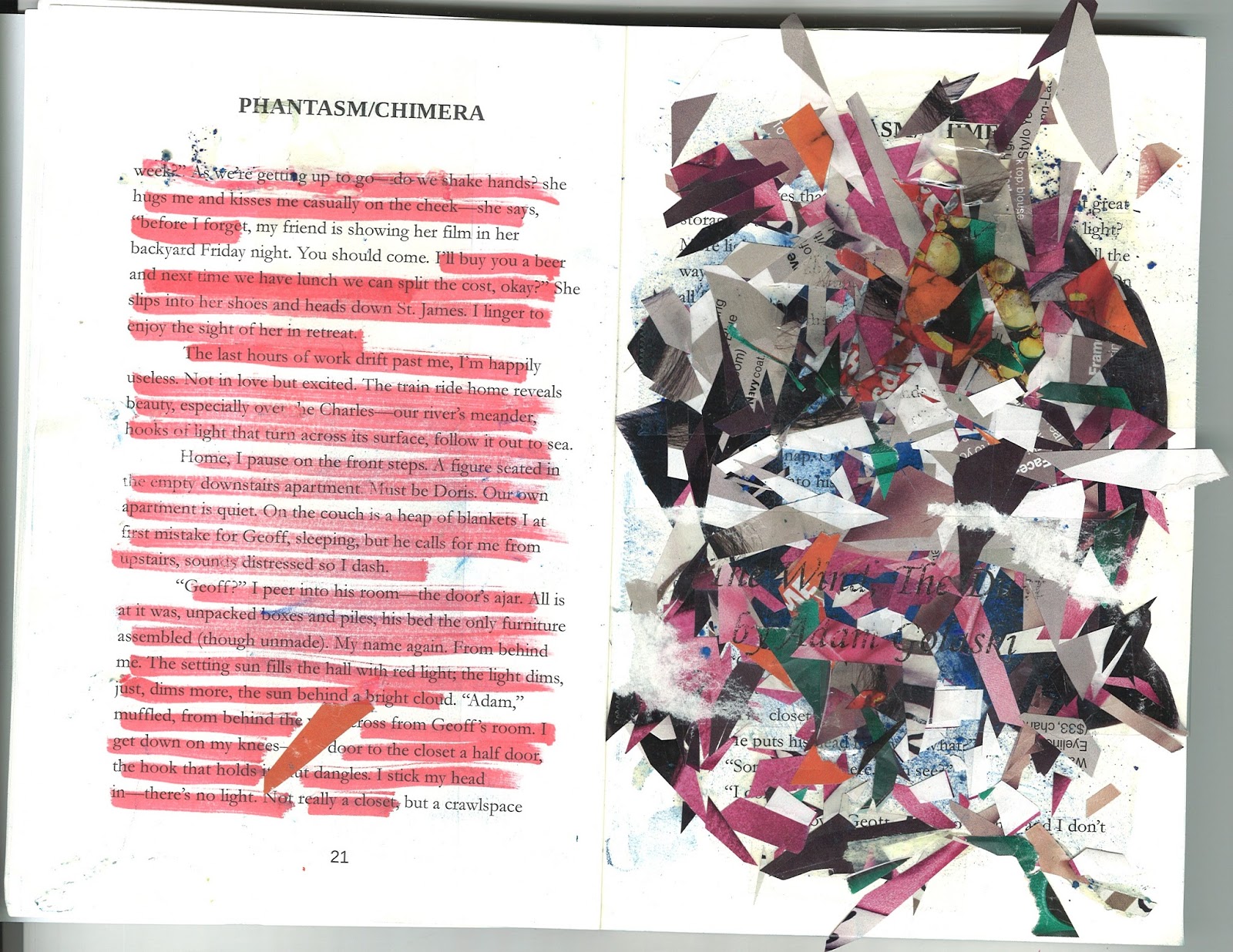
162. from Plutonian } "The Wind, The Dust."


Initially, when Jay Decay requested a story for his as-of-yet named anthology of “the best writers working in the weird horror genre,” I declined. We agreed, instead, on an interview for The Plutonian.

And then I changed my mind.

I sent “The Wind, The Dust,” from a sequence of stories I’m writing for a collection tentatively called Autobiography. (Another of those stories, “Woods (Marion),” can be read online at Essays & Fictions.)

A few weeks ago, a proof of Jay’s anthology now called Phantasm/Chimera arrived. It’ll be officially released at Necronomicon next week.

Reading it, I realize I have lost track of current horror fiction. I haven’t read a "best of" in many years, or bought a new collection. I knew just one name in the anthology: Brian Evenson. (Evenson’s story, “The Hole,” reminds me of the best scenes from his Aliens novel.) Christopher Slatsky, Jon Padgett, Livia Llewellyn, etc.—are all new to me, though apparently bright lights in the current horror scene. Clint Smith, too, whose “Fiending Apophemia” is the best story in the book—a candidate for those best ofs I haven’t been reading.

If, like me, you’re not attending Necronomicon, you can get your copy at Create Space.

Nervous about committing 16 bucks? Our friend Des Lewis is real-time reviewing the anthology. Of mine he wrote, “The plot did not seem to care whether I was frightened or not, but I was.”

[ The image above: a spread from the anthology—two pages from “The Wind, The Dust,” with my most recent edits. ]

Friday, July 28, 2017

161. from Bus Stop } series 1 - 4.


[ Bus w/ Leaves 1 (cherry tree leaves, water, bus stop sign) ]


[ More Bus w/ Leaves (cherry tree leaves, water, bus stop sign) ]


[ Bus 8 (leaves, stem, mud, bus stop sign) ]


[ Brown Bus 2 (frond, water, bus stop sign) ]


Thursday, July 27, 2017

160. Found notes on } David Lynch’s “Boat.”


--> “At the start of the film boat, a voiceover appeared. That is a girl’s voice….” “When this voice talking… trying to cope with the flashbacks that she’s receiving.” “She woke up in a forest, the light was so bright that she couldn’t….” “…[W]e can see forest… we can see water….” “…[V]oiceovers they seem more knowledgeable about what’s going on in their lives during the moment and what point changed it forever. The women in Boats seems not to know anything about what happened to her prior and what is happening during the moment.” “She is tired and wants to sleep…. She begins to describe what are on the boat just like the string with strange shape.” “The film starts with a tree in a forest, the light is so bright that we can’t see anything clearly. …[T]here is too bright… the bright light changes into dark night….” “Then everything became dark, the girl’s voice appeared again, ‘boat still moving fast, I feel tired…’.” “The camera turned to the man and he said ‘It worked.’” “…[T]he story stopped with the picture of the moon. ... We want to see beautiful things….”

Thursday, July 13, 2017

159. from the Paris binder } Dec. '98.


[ 1. Paris binder front cover ]


[ 2. Paris binder At the Musee d'Orsay poem ]


[ 3. Paris binder cross-outs ]


[ 4. Paris binder opium perfume ]

Friday, July 7, 2017

158. Ghosts & } trifles.


“Worse than myself” is a phrase taken from “The Uncommon Prayer-Book,” a story by M. R. James. At The Smart Set, I wrote about Oxford World’s Classics’ latest reprint of James’ Collected Ghost Stories. Also discussed: The Ring, Kate Bush, H. P. Lovecraft, and It Follows. At least have a look at Shannon Sands’ charming illustrations. (See her illustration for “Casting the Runes” above.)

For SHARKPACK, a response to the poem “Traveler’s Monologue” by Cassie Pruyn—“a horse with a second mouth. Mouth and mouth inside its mouth. Duplicitous.”

Rose Metal Press authors were invited to contribute to the Song of the Week series at Coldfront. I wrote about “Nunu” by Mira Calix. Poets off poetry, it says—not so!